AI Overview
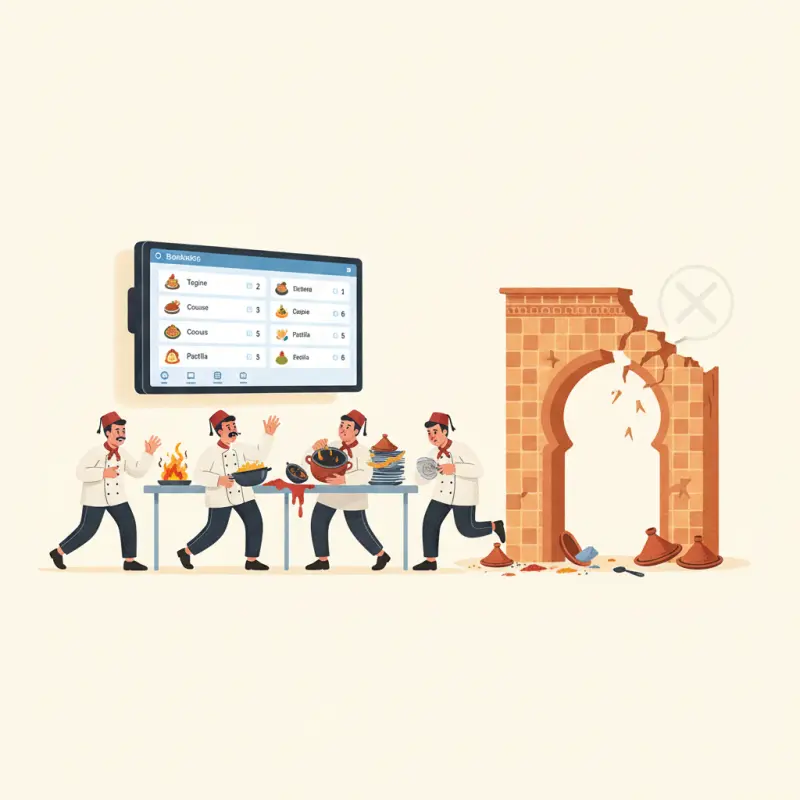
SambaPOS kitchen display systems fail in most Moroccan restaurants because vendors quote only software costs while hiding the true 70% expense of implementation. Staff revert to paper tickets when tablets freeze during dinner rushes, hardware fails from kitchen heat and grease, and training takes 40+ hours. A Casablanca restaurant tracked real costs at 26,000 MAD versus the quoted 8,000 MAD license fee. Failed implementations show 14% error rates and 18-minute ticket times, while working systems achieve 3% errors and 12-minute service. Consumer tablets can't handle kitchen environments, and most SambaPOS kitchen display setups lack proper station routing for complex orders. Choose commercial-grade hardware designed for restaurant kitchens, or consider integrated POS solutions that include kitchen displays as core features rather than expensive add-ons.
Table of Contents
Your SambaPOS kitchen display looked perfect in the demo. Three months later, your staff prints paper tickets anyway.
This pattern repeats across restaurants in Casablanca, Marrakech, and Agadir. The digital kitchen revolution promised efficiency, but delivered tablets that freeze during the dinner rush and orders that vanish between prep stations. Restaurant owners invest thousands of dirhams in kitchen display system software, only to watch their staff tape paper backups next to expensive screens.
The Hidden Costs of Failed Kitchen Display Implementation
Most SambaPOS kitchen display vendors quote you the software license. They don't mention the other 70% of your actual costs.
The 30% Rule Most Vendors Don't Mention
Your initial investment covers just 30% of the true cost. Hardware fails at predictable rates — one in three tablets needs replacement within 18 months of kitchen use. Steam, heat, and grease destroy consumer-grade electronics faster than any warranty covers. Add 40 hours of staff training that nobody budgets for, plus the parallel paper system you'll run "temporarily" that becomes permanent.
A restaurant in Casablanca's Maarif district tracked their real costs over six months. The SambaPOS license cost 8,000 MAD. Their total investment, including replacement hardware, lost productivity during training, and maintaining dual systems, reached 26,000 MAD.
Real Numbers from Casablanca Restaurants
| Metric | With Failed KDS | With Working KDS |
|---|---|---|
| Order Error Rate | 14% | 3% |
| Average Ticket Time | 18 minutes | 12 minutes |
| Monthly Downtime Cost | 4,200 MAD | 0 MAD |
| Staff Overtime Hours | 32 hours | 8 hours |
These numbers come from five restaurants using SambaPOS kitchen display systems. The "failed" category includes any restaurant where staff reverted to paper tickets more than twice per week. Kitchen management software only saves money when it actually works.
Stack audit
What do you currently use?
Tick what you have. We’ll show what OCHI replaces or connects to.
Station Routing Reality — Where SambaPOS Kitchen Display Falls Short
Your kitchen has five stations. An order needs items from three of them. This is where most kitchen ordering system implementations break.
The Grill-to-Garnish Problem
A tagine order enters your system. The protein goes to the grill station, vegetables to prep, and the final assembly happens at the garnish station. In theory, your SambaPOS kitchen display tracks each component. In practice, the grill finishes first and sits warming while prep catches up. The garnish station can't see that the protein is ready because their screen only shows their tasks.
This coordination gap creates the 12-minute delays that kill table turnover. Your kitchen display system software shows green checkmarks, but customers wait. The technology tracks tasks, not timing. Central kitchen software needs to understand dependencies, not just distribute orders.
What Actually Works in Split Kitchens
Here's what vendors won't tell you: paper tickets beat digital displays for certain workflows. A busy pastilla station needs to see all orders at once, not scroll through screens. Physical tickets on a rail give instant visual feedback about workload.
The most efficient kitchens in Agadir use hybrid systems. Digital displays for main courses, paper tickets for appetizers and desserts. They match the tool to the task instead of forcing everything digital. Your kitchen management software should enhance your workflow, not dictate it.
OCHI's Kitchen Display System — Built for Moroccan Restaurant Reality
OCHI approaches kitchen displays differently. Instead of selling you hardware that fails, the system runs on devices you already own — tablets, phones, or existing kitchen screens.
WebSocket Real-Time Updates That Don't Crash
Technical reliability comes from WebSocket connections that maintain state even when your internet stutters. Each station sees color-coded priorities: red for orders approaching 15 minutes, yellow for standard timing, green for just placed. During Ramadan rush periods, the system automatically adjusts timing expectations based on current kitchen load.
Unlike locked-in systems, OCHI's KDS integrates with your existing setup. Keep your current POS, add digital efficiency where it helps. The kitchen ordering system adapts to you, not the other way around.
Scenario: 60% Fewer Order Errors at Restaurant Riad Atlas
Restaurant Riad Atlas in Marrakech switched from SambaPOS to OCHI's integrated platform last summer. Their error rate dropped from 15% to 6% in the first month. The key difference: per-item status tracking that actually works across stations.
Their head chef explains it simply: "Each station sees what others are doing. No more guessing if the tajine base is ready for my vegetables." The investment comparison tells the real story. SambaPOS licensing plus hardware: 35,000 MAD annually. OCHI's complete platform including KDS: included in their zero-commission structure. They pay nothing extra for kitchen display system software that actually works.
The Decision Framework — SambaPOS vs. Integrated Solutions
Your choice depends on three factors: restaurant size, kitchen complexity, and growth plans.
When SambaPOS Kitchen Display Makes Sense
Single-location restaurants with simple menus might find SambaPOS adequate. If you run fewer than 100 orders daily with minimal station routing, the basic functionality suffices. Your kitchen layout should be linear — prep to cook to plate — without complex dependencies.
Consider your existing technology too. If you're already deep in the SambaPOS ecosystem with their POS and inventory, adding their KDS maintains consistency. Just budget triple the quoted price for the real implementation cost.
When You Need a Different Approach
Multi-location restaurants need centralized control that standalone systems can't provide. If you're managing branches across Casablanca and Rabat, you need unified reporting and consistent kitchen workflows. Integration with delivery platforms matters too — your kitchen display must handle dine-in and delivery orders equally well.
Think beyond today's needs. A growing restaurant in Agadir's Nouveau Talborjt started with 50 daily orders. Six months later, they handle 200. Their original SambaPOS kitchen display couldn't scale. Switching systems mid-growth disrupts operations and frustrates staff who just learned the first system.
Modern restaurants need more than digital order tickets. They need kitchen intelligence that prevents bottlenecks before they happen. Visit ochi.ma/partners to see how integrated kitchen management transforms operations. The future of restaurant kitchens isn't just digital — it's intelligent.
Experience OCHI's kitchen display system at votrenom.ochi.ma — no setup fees, no licensing complications.
Frequently Asked Questions
Why do SambaPOS kitchen display systems fail in restaurants?
Most failures occur because consumer tablets can't withstand kitchen heat, steam, and grease. Staff revert to paper when screens freeze during busy periods or orders disappear between prep stations.
What are the hidden costs of SambaPOS kitchen display implementation?
Hardware replacement accounts for 40% of costs, staff training adds another 30%, and running parallel paper systems increases the total investment by 225% over the quoted license fee.
How much do SambaPOS kitchen display systems really cost Moroccan restaurants?
While licenses start at 8,000 MAD, total implementation costs reach 26,000 MAD including hardware failures, training time, and maintaining backup paper systems.
What makes a kitchen display system work reliably in restaurant kitchens?
Commercial-grade screens rated for kitchen environments, proper station routing for complex orders, and integration with POS systems that don't require separate software licenses.
Should Moroccan restaurants choose SambaPOS kitchen display over integrated solutions?
Integrated POS platforms with built-in kitchen displays typically cost less and work more reliably than separate SambaPOS add-ons that require additional hardware and training.
Restaurant owners · Weekly
The guide to running a restaurant in 2026.
One article per week. No commission advice. Just honest operational insight for Moroccan restaurants.

Blog Manager
Comments
No comments yet. Be the first to share your thoughts.