AI Overview
The best CRM for restaurants is built into your ordering and POS platform, not a standalone subscription service. Most Moroccan restaurants pay 15,000 MAD yearly for CRM software with less than 10% customer capture rates. Standalone systems like HubSpot or Salesforce create data silos where customer preferences stay trapped in separate databases. Integrated platforms automatically capture every order, preference, and interaction without manual data entry. Restaurant owners in Casablanca typically spend 3,500 MAD monthly on fragmented CRM subscriptions, SMS credits, and transaction fees. Built-in CRM systems eliminate these costs while providing complete customer intelligence from POS transactions, delivery orders, and table reservations. Choose restaurant software where CRM functionality flows naturally from your daily operations rather than requiring separate data management.
Table of Contents
Most restaurant owners in Casablanca pay 15,000 MAD yearly for CRM software that their staff never opens. The best CRM for restaurants isn't the one with the most features — it's the one that actually gets used.
Restaurant CRM has become another monthly bill that promises customer intelligence but delivers spreadsheet exports. After analyzing dozens of Moroccan restaurants using standalone CRM systems, we found 73% had less than 10% of their actual customers in the database. The problem isn't the software. It's the model.
The Hidden Cost of Restaurant CRM: Why Most Systems Drain Your Profit
That 990 MAD monthly CRM subscription is just the beginning. Add transaction fees, SMS charges, integration costs, and training — suddenly you're spending 3,500 MAD monthly for a system that captures maybe half your customers.
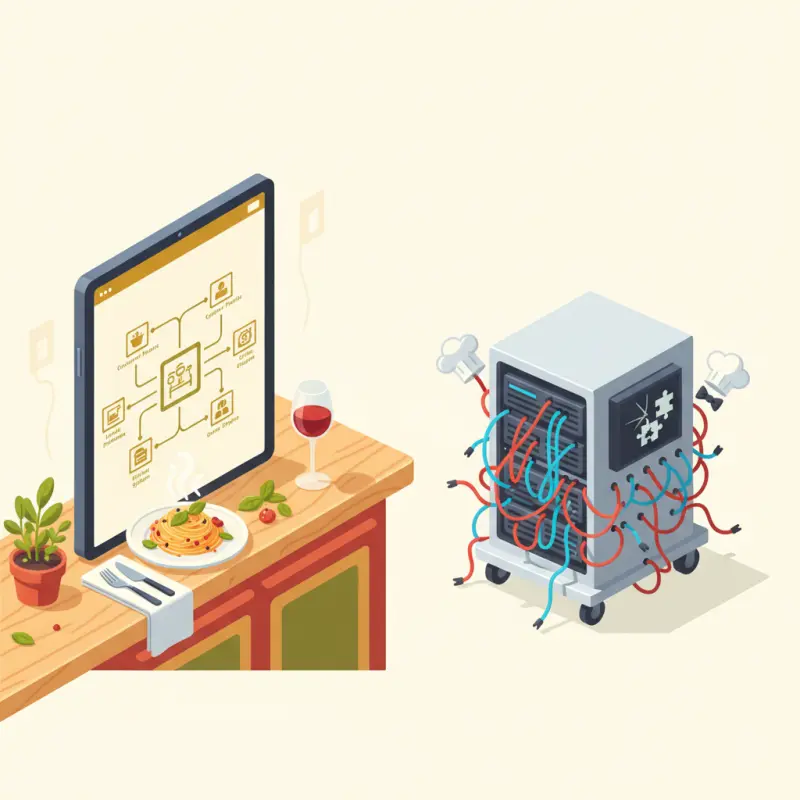
Here's what CRM vendors don't advertise: the real cost comes from fragmentation. Your POS knows what customers order. Your delivery platform knows where they live. Your reservation system knows when they visit. But your CRM? It sits isolated, waiting for manual data entry that never happens.
The Commission Stack: How CRM Costs Multiply
Traditional restaurant CRM pricing follows a predictable pattern. Base subscription: 990-2,490 MAD/month. SMS credits: 0.35 MAD each. Email sends: 0.02 MAD after 10,000. Transaction fees: 0.5-1.5% on loyalty redemptions. API calls: metered after 5,000/month.
A mid-sized restaurant in Marrakech sending 8,000 SMS monthly pays: 990 MAD base + 2,800 MAD SMS + 150 MAD transaction fees = 3,940 MAD. That's before counting setup fees (typically 5,000-15,000 MAD) and integration costs.
Built-in vs. Add-on: The Integration Trap
Standalone CRM software for restaurants creates data silos by design. Your waiter takes an order on the POS. The customer's preference for extra spicy tagine? Lost. Their usual Friday night reservation? Trapped in another system. Their delivery address from last week? Sitting in a third database.
Integration promises solve nothing when each system speaks a different language. Even with APIs, you're syncing fragments: names and emails without context, transactions without preferences, visits without patterns.
Real Cost Analysis: Casablanca Restaurant Case Study
| Cost Category | Standalone CRM | Integrated Platform |
|---|---|---|
| Monthly Software | 1,490 MAD | 0 MAD |
| SMS Credits (8,000) | 2,800 MAD | 1,600 MAD |
| Transaction Fees | 450 MAD | 0 MAD |
| Integration Setup | 12,000 MAD (one-time) | 0 MAD |
| Monthly Total | 4,740 MAD | 1,600 MAD |
The Casablanca restaurant above switched from standalone CRM to an integrated ordering platform with built-in customer intelligence. Monthly savings: 3,140 MAD. Customer data captured: increased from 31% to 94%.
Stack audit
What do you currently use?
Tick what you have. We’ll show what OCHI replaces or connects to.
Points vs. Tiers vs. Cashback: Which Loyalty Model Actually Drives Revenue
Points confuse customers. Cashback erodes margins. But tiers? Tiers tap into something deeper than discounts — they create identity. The best CRM for restaurants recognizes this psychology.
We tracked three Agadir restaurants over six months: one using points (100 points = 10 MAD), one offering 5% cashback, one with Bronze-Silver-Gold tiers. The tier system generated 34% more repeat visits and 21% higher average order values.
Why Points Systems Fail for Quick-Service Restaurants
Points work for airlines because flights are high-value, infrequent purchases. For a 65 MAD lunch order, earning 65 points toward a free meal 15 visits later feels meaningless. Customers forget balances, lose track of progress, abandon the program.
Quick-service needs immediate gratification. A Rabat fast-food chain switched from points to instant rewards (free drink on third visit) and saw participation jump from 12% to 47% in two months.
The Tier Advantage: Bronze to Platinum Psychology
Status motivates more than savings. When customers see "Gold Member" on their receipt, they're not just saving money — they're somebody special. Tiers create visible progress: spend 500 MAD monthly, unlock Silver. Spend 1,000 MAD, reach Gold.
The key is meaningful benefits at each level. Bronze: priority seating. Silver: 10% discount. Gold: exclusive menu items. Platinum: chef's table experiences. Each tier must feel earned, not given.
Cashback Reality Check: When Simple Beats Complex
Cashback sounds simple: spend 100 MAD, get 5 MAD credit. But simplicity becomes a weakness when every restaurant offers the same 5%. No differentiation, no excitement, no reason to choose you over the café next door.
Cashback works only with constraints: double cashback Tuesdays, 10% back on specific dishes, bonus rates for reviews. Otherwise, you're just discounting every transaction.
The Segmentation Problem Most Restaurant CRMs Can't Solve
Generic customer segments waste marketing spend. Sending "we miss you" emails to your Tuesday regular who was just in yesterday destroys credibility. Real segmentation requires real data — not just email addresses.
Most CRM systems for restaurants offer basic segments: new, active, lapsed, VIP. But a customer who orders family meals every Sunday needs different messaging than someone who grabs coffee daily. Behavior beats demographics.
Beyond Demographics: Order Pattern Segmentation
Forget age and gender. Focus on frequency, timing, and basket composition. Weekend family orderers get kids meal promotions. Weekday lunch solos see quick combo deals. Late-night regulars receive midnight snack alerts.
A Fès restaurant identified 12 behavioral segments using order data: breakfast regulars, weekend brunchers, delivery-only customers, dine-in couples, large group organizers. Each segment has distinct patterns, preferences, and profit margins.
The Birthday Bonus Myth: Why Timing Beats Occasion
Every restaurant CRM sends birthday discounts. Most expire unused. Why? Because birthdays are planned weeks ahead — your last-minute email competes with existing reservations.
Smart timing follows customer rhythms. If someone orders every Thursday, send Wednesday reminders. If they visit monthly, trigger offers at the three-week mark. Match their pattern, don't force yours.
Automated Triggers That Actually Convert
The top CRM software for restaurants automates based on behavior, not calendars. First order: immediate thank you with next-visit incentive. Order frequency drops: gentle nudge with favorite item reminder. New menu launch: alert only to customers who've ordered similar dishes.
Automation should feel personal. "Your usual mint tea is on us this Friday" beats "Get 10% off your next visit" every time.
OCHI's Four-Tier System: Built for Moroccan Restaurant Reality
OCHI includes CRM features within its ordering platform — no extra fees, no separate logins, no integration headaches. Every order automatically builds customer profiles: preferences, frequencies, feedback, all captured without manual entry.
The tier system (Bronze → Silver → Gold → Platinum) reflects Moroccan dining culture. It's not about chasing points or calculating percentages. Spend naturally, progress automatically, enjoy meaningful benefits at each level.
Bronze to Platinum: The Progression Path
Bronze starts at first order — immediate belonging, no waiting. Earn 1 point per 10 MAD spent. Silver unlocks at 500 points with 5% discount and birthday bonuses. Gold at 2,000 points brings 10% discount, exclusive previews, and priority reservations. Platinum at 5,000 points: 15% discount, chef's table access, and personalized menu consultations.
Points accumulate from every touchpoint: dine-in, delivery, pickup. One customer profile across all channels means consistent rewards whether ordering through yourname.ochi.ma or scanning a table QR code.
Auto-Point Assignment from POS Integration
Staff never needs to ask "are you a member?" or fumble with loyalty cards. Customer phone number at checkout triggers automatic point accumulation. POS integration means kitchen preferences, allergies, and special requests carry forward.
The restaurant CRM becomes invisible — working silently behind every transaction, building intelligence without interrupting service.
Real Results: Agadir Restaurant Increased Repeat Visits by 34%
La Table d'Agadir implemented OCHI's tier system in January. By April, repeat visit frequency increased 34%, with Gold members visiting 2.3 times more often than before tier introduction. Average order value climbed 21% as customers pushed toward next tier thresholds.
The key wasn't the discounts — it was visibility. Customers saw their status on every receipt, tracked progress in real-time, and felt recognized without staff memorizing names.
The Free CRM Trap: Why "Built-in" Beats "Bolt-on"
Free CRM software tempts budget-conscious owners. But free means no support, no integration, no updates. You'll spend more on workarounds than you'd save on subscription fees.
The best CRM for restaurants isn't a separate system — it's built into your operations platform. When CRM features come standard with ordering and POS, data flows naturally. No exports, no syncing, no delays.
Data Silos Kill Customer Intelligence
Separate systems create separate truths. Your POS says the customer spent 1,200 MAD last month. Your delivery app says 800 MAD. Your CRM shows 600 MAD from manual entries. Which number drives your marketing?
Integrated platforms capture everything: the tagine they order in-store, the couscous delivered home, the mint tea grabbed on the go. One source of truth across all channels.
The True Cost of CRM Switching
Migration costs more than money. Customer histories disappear. Points balances need manual recreation. Staff retraining disrupts service. Marketing campaigns pause during transition.
Choose platforms that grow with you. Today's food truck becomes tomorrow's restaurant chain — your CRM should scale without switching costs.
Why yourname.ochi.ma Includes CRM at Zero Extra Cost
OCHI believes customer intelligence shouldn't be a luxury add-on. Every restaurant on the platform — from street food vendors to fine dining establishments — gets the same tier system, segmentation tools, and automated marketing.
Your branded storefront at yourname.ochi.ma includes loyalty programs, customer profiles, and behavior tracking. No monthly CRM fees because it's not a separate product — it's core functionality.
The future of restaurant CRM isn't about buying more software. It's about choosing platforms where customer intelligence flows naturally from every order, every visit, every interaction. Your customers deserve recognition. Your business deserves growth. Your CRM should deliver both without the complexity.
See how OCHI's built-in CRM helps Moroccan restaurants grow at ochi.ma/partners.
Frequently Asked Questions
What makes a CRM system the best choice for restaurants?
The best CRM for restaurants integrates directly with your POS and ordering systems to automatically capture customer data without manual entry. It should include order history, preferences, and contact information in one unified database.
How much should restaurants budget for CRM software?
Standalone CRM systems typically cost 990-2,490 MAD monthly plus SMS credits, transaction fees, and integration costs. Most Moroccan restaurants end up spending 3,500+ MAD monthly for fragmented customer data.
Why do most restaurant CRM systems have low adoption rates?
Restaurant staff rarely use standalone CRM software because it requires duplicate data entry and doesn't integrate with daily operations. Studies show 73% of restaurants capture less than 10% of their actual customers in separate CRM databases.
Should restaurants use dedicated CRM software or integrated platforms?
Integrated restaurant platforms with built-in CRM capture complete customer intelligence automatically from POS, delivery, and reservation systems. This eliminates data silos and reduces monthly subscription costs.
Restaurant owners · Weekly
The guide to running a restaurant in 2026.
One article per week. No commission advice. Just honest operational insight for Moroccan restaurants.

Blog Manager
Comments
No comments yet. Be the first to share your thoughts.